The following information has been obtained from Inflight Guide: Air to Ground Coordination. You may view the document here: CAP Communications Sheet
Section 1: Pre-Flight Planning & Initial Contact
To prevent confusion and asset waste during coordination, establish common parameters before departure:
Common Mapping: Both assets must use the same reference map (e.g., State Topographic Atlases). Ground teams typically lack Sectional Charts, and aircrews rarely carry State Highway maps.
Communications Protocol: Prearrange call signs and primary/secondary frequencies.
Vehicle Identification: Aircrews must obtain specific vehicle descriptions, including distinguishing marks like roof arrows or numbers.
Rendezvous Windows: Set rendezvous windows (typically ±30 minutes). Account for ground team speeds averaging 45–50 mph on highways.
Running Rendezvous: Ground teams transmit current GPS coordinates to the aircraft to allow a direct intercept via aircraft GPS.
Section 2: Two-Way Radio Failure Protocols
If two-way radio contact cannot be established or maintained:
Daytime Procedure
Circle Position: Aircraft circles over a prominent point directly ahead of the ground vehicle to gain attention until the vehicle stops.
One-Way Transmissions: Aircrew attempts one-way communication using aviation radios on 121.775, 121.6, 122.9, or 123.1 MHz (avoid 121.5 MHz). Ground teams listen using receivers like the Little L-Per.
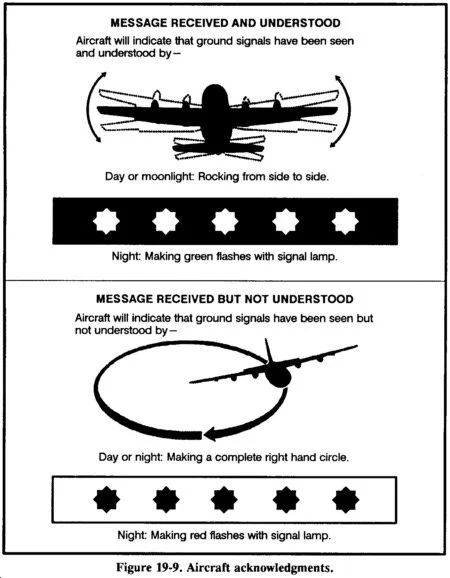
Acknowledgment: Ground team waves and repeatedly flashes headlights once the message is received.
Escalation: If unacknowledged, proceed with visual maneuvering signals.
Nighttime Procedure
Aircraft circles above the vehicle.
Ground team stops and turns off headlights.
Aircrew transmits one-way message over pre-briefed frequencies.
Ground team repeatedly flashes headlights to acknowledge receipt.
Section 3: In-Flight Visual Direction Signals
When direct radio communication is unavailable, aircrews execute specific maneuvers to direct ground assets (Formated as Target Ground Action: Action Maneuver Signal)
Keep Up / Continue: Fly over team from behind in an oval "Daisy Chain" pattern, keeping the majority of the flight path behind the vehicle to "push" it forward.
Turn Around: Approach from the rear, turn sharply in front of the vehicle, and fly directly back over it against its direction of travel.
Turn at Intersection: Approach from the rear and make a sharp turn left or right directly over the intended junction.
Stop Vehicle: Approach low and head-on toward the moving vehicle without performing a turn.
Dismount Vehicle: Execute two or more low passes in the same direction over a stopped ground vehicle.
Objective Location: Perform turns-about-a-point over the target. The low wing points directly to the objective.
Section 4: Vehicle Escort Operations
Because aircraft airspeeds far exceed ground vehicle speeds, crews must manage positioning using specific patterns rather than flying excessively slow:
Daisy Chain: Racetrack loops flown behind the vehicle.
Creeping Line: Paralleling the vehicle's road, crossing over, and paralleling on the opposite side.
Sawtooth Pattern:
Aircraft positions at the vehicle's 6 o'clock position.
Turn 60∘ away from the road (typically right for pilot visibility) for approximately 1 minute.
Turn 60∘ back toward the road.
Adjust leg length aft of the vehicle to prevent overshooting.
Section 5: Surface-to-Air Visual & Panel Signals
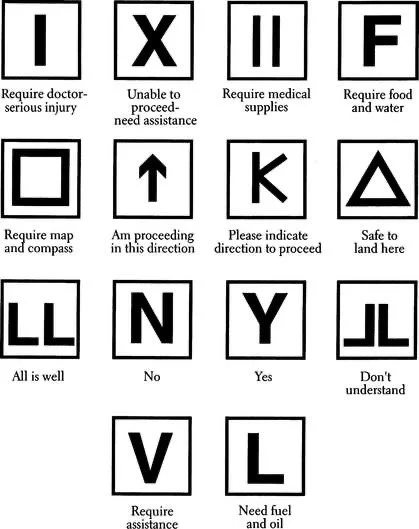
Ground teams and survivors can use body positions, ground markings, or dual-colored paulins/panels to communicate.
Standard Ground Symbols:
V: Require Assistance
X: Require Medical Assistance
N: No / Negative
Y: Yes / Affirmative
↑: Proceeding in this direction
Body Signals:
Lie Supine: Urgent medical assistance needed.
Wave One Arm Overhead: All OK / Do not wait.
Both Arms Horizontal: Need mechanical assistance / Long delay.
Both Arms Vertical: Pick us up / Plane abandoned.
Section 6: Emergency Message Airdrop Procedures
Regulatory Warning: CAPR 70-1 prohibits dropping objects from CAP aircraft except to prevent the loss of life. FAA Part 91.15 requires reasonable precautions to prevent hazard to persons or property.
Drop Execution Steps:
Preparation: Pack items into a lightweight container. Attach a streamer wrapped tightly around the container to prevent it from fouling on the aircraft tail surface during release.
Run-In: Fly along the target axis (e.g., paralleling a road). Conduct high-altitude practice passes to check for obstacles.
Delivery: The observer holds the container outside and low in their right hand. Release the container when the target intersects the aircraft's landing gear strut.